
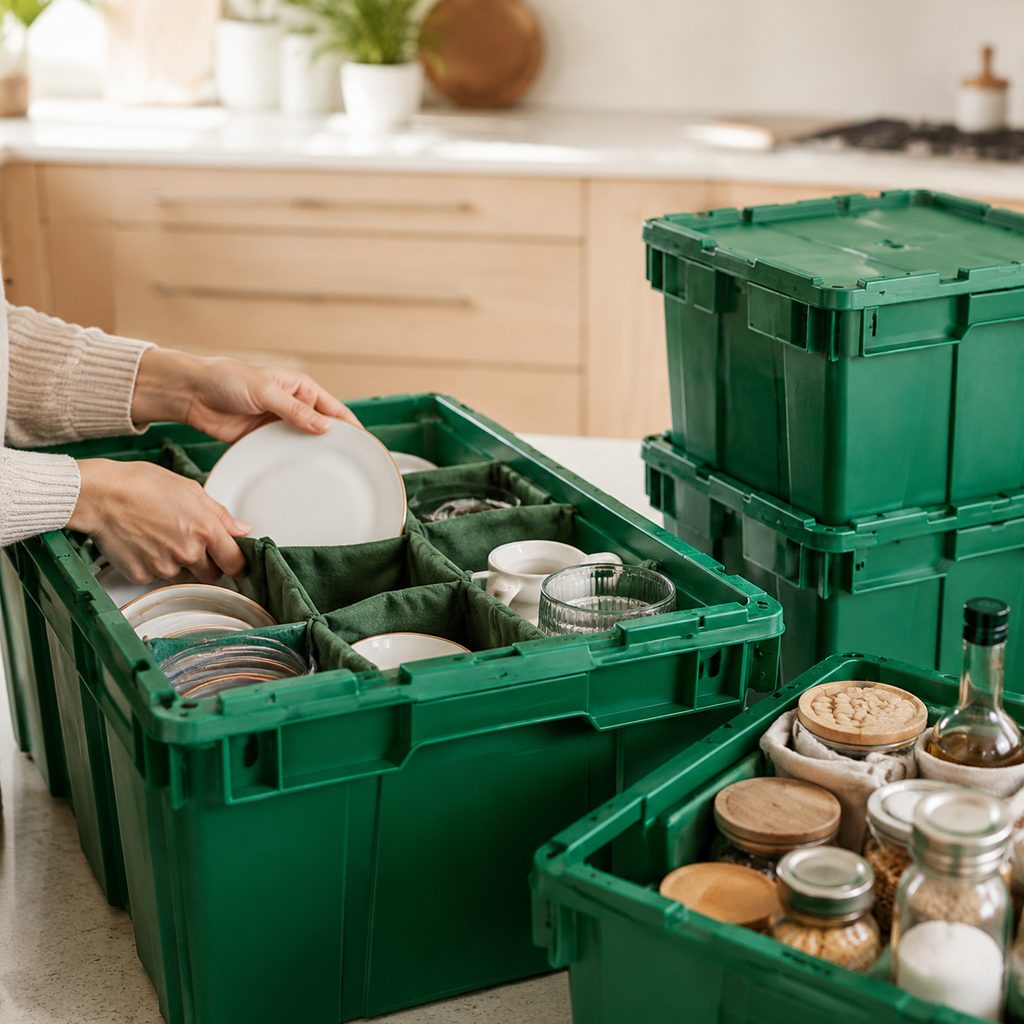
The kitchen is where moves go sideways. It is the densest room in the house, the most fragile, the last one you can pack, and the first one you need working again. People leave it for the night before and then it is 1am and they are wrapping a colander in a dish towel.
Do it in this order and it stops being the worst part of the move.
Start three days early, not the night before
You can live out of one pot, one pan, two plates, two bowls, two glasses, and a couple of forks for three days. Set those aside in a labeled bin. Everything else in the kitchen is now fair game to pack, which means the panic disappears.
Then work in passes. Pass one is everything you have not touched in six months: the back of the pantry, the good china, the second set of mixing bowls, the appliances on the high shelf. Pass two is daily dishes and cookware. Pass three, on move day morning, is the survival kit.
Dishes, glass, and cookware
Plates ride on edge, like records
This is the single biggest upgrade to how you pack dishes, and almost nobody does it.
Laying plates flat and stacking them means every plate carries the weight of the ones above it. One bump on a stair and the bottom plate cracks. Standing them on edge, vertically, like vinyl in a crate, means the force travels down through the rim, which is the strongest part of the plate.
- Line the bottom of the container with a folded towel or a layer of crumpled paper.
- Wrap each plate individually in packing paper. Newspaper works but the ink transfers.
- Stand them on edge in a row, all facing the same direction.
- Pack the row snug so nothing can tip. Fill leftover space with dish towels.
- Keep it under about 30 pounds. Dishes get heavy faster than you expect.
Bowls are the exception. Nest them in stacks of three or four with paper between each, then lay the stack down on its side, cushioned.
Glassware and stemware
Glasses fail from the rim, so protect that first. Stuff a small ball of paper inside each glass, then roll the glass in paper on a diagonal, tucking the ends in as you go. Stand glasses upright, never on their sides, and never stack one inside another unpacked.
Wine glasses want a divided box or a lot of padding around the stems. If you have a set worth real money, wrap the bowl and the stem separately, then wrap them together as one unit.
Put a layer of towels or crumpled paper on top of the last row so nothing shifts up into the lid. If you can close the container and shake it gently and hear movement, add more padding.
Pots, pans, and knives
Cookware is the easy part. Nest pots with a dish towel between them, keep lids flat along the side, and use cast iron as the bottom layer so it is not sitting on top of anything breakable. Wrap nonstick surfaces so they do not scratch each other.
Knives get their own treatment. Slide each blade into a folded piece of cardboard or a sleeve, tape it closed, and label it. The person unpacking might not be you, and reaching blind into a container of loose knives is how move day ends at an urgent care in Dilworth.
Small appliances
If you kept the original box, use it. If not:
- Remove and separately wrap anything glass or removable: blender jars, food processor bowls, air fryer baskets, coffee carafes.
- Tape cords to the body of the appliance so they do not catch on anything.
- Wrap the whole unit in paper or a towel.
- Group by weight. The stand mixer does not go on top of the toaster.
Be honest about the appliance graveyard while you are at it. The bread machine used twice, the second slow cooker, the juicer. Moving them costs you space and effort in both directions.
Pantry and spices
Pantry goods are heavy and mostly replaceable, so this is where you thin out hard. Toss anything expired, donate unopened non-perishables to a food pantry, and only move what you actually eat.
For what makes the trip:
- Tape lids on anything that can open. Olive oil in a container of linens is a bad afternoon.
- Bag anything powdery: flour, sugar, rice. Zip bags, then the container.
- Spices go in one small bin together, upright, so you can find them the first time you cook.
- Keep pantry containers small. A large box of canned goods is a back injury.
What not to move at all
Some things should not go in the truck, and most professional movers will refuse them outright:
- Propane tanks, lighter fluid, and charcoal starter
- Aerosols, oven cleaner, drain cleaner, and most solvents
- Open liquor bottles and anything already leaking
- Perishables, opened refrigerated items, and the freezer contents
- Ancient spices, which lose everything in a year anyway
Use up the freezer in the two weeks before. Give away what is left. It is faster than trying to keep it cold.
The open first box
Pack one container last, label it loudly, and put it in the truck last so it comes off first. Inside:
- Coffee setup and a kettle or the machine
- One pan, one pot, a spatula, a chef knife, a cutting board
- Two plates, two bowls, two glasses, silverware for two
- Dish soap, a sponge, paper towels, trash bags
- Scissors and a box cutter
- Salt, pepper, olive oil
Night one in a new place is not the night to cook. It is the night to make coffee in the morning without digging through 12 containers.
A note on containers
Kitchens are exactly where rigid containers pay off, because dish weight is unforgiving on a cardboard bottom that has been taped once. If you want the full comparison, we wrote up rental crates versus buying cardboard without pretending cardboard never wins.
However you pack it, budget more containers for this room than any other. Our sizing guide puts a normal kitchen at 8 to 15 on its own.
If you want crates dropped a week out so you can do the kitchen in passes instead of all at once, the packages are here and booking takes a couple minutes.